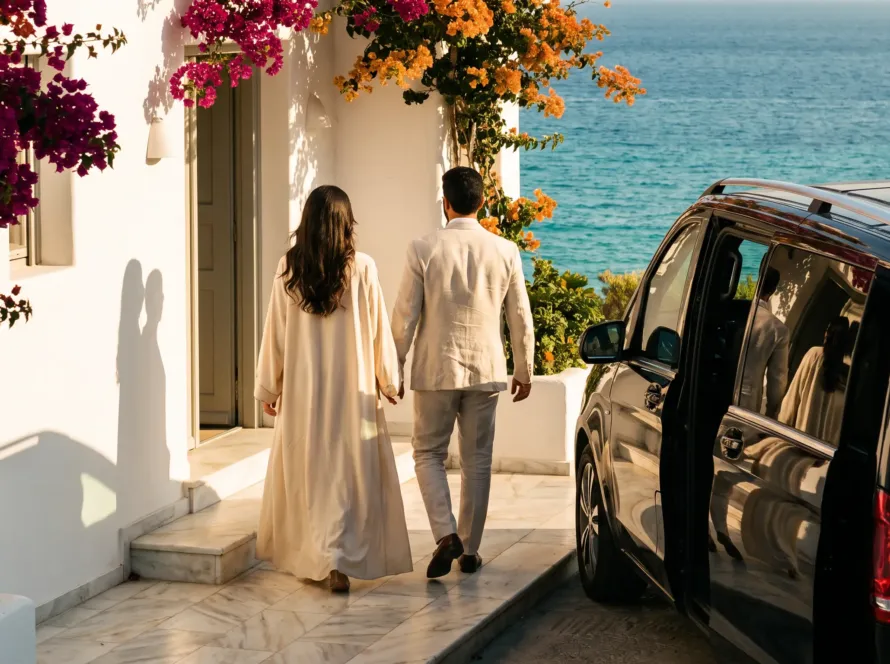
Most people who know Corfu know it from the water. The villa above the bay, the boat to a quiet cove, the long lunch where the olive trees meet the sea. It is a version of the island that is easy to love and easy never to leave.
But Corfu has another life, one that sits higher up and further in. It is found in stone villages that were built to watch the coast rather than face it, in Venetian lanes that have barely changed in centuries, and in viewpoints that make the most expensive terrace on the island look modest.
Three villages in particular reward the effort of leaving the pool behind: Old Perithia in the north-east, Lakones above Paleokastritsa, and Afionas on the north-west coast. Each is a different kind of Corfu. Together they are the island most visitors never see.
| Village | From Corfu Town | What it offers | Best paired with |
| Old Perithia | Just over an hour | A restored Venetian village on Mount Pantokrator | Lunch in the village square, Kassiopi |
| Lakones | 40 to 50 minutes | Bella Vista viewpoint over Paleokastritsa | Angelokastro, Paleokastritsa Monastery |
| Afionas | Around an hour | A clifftop village above Porto Timoni | The walk to Porto Timoni, sunset at Louloudi |
| Pelekas | Around 25 minutes | Kaiser’s Throne, the island’s classic sunset | The Achilleion, an evening table nearby |
Why the Interior Is the Real Corfu
For centuries, the coast was where danger arrived. Pirate raids pushed Corfiots inland and uphill, and the villages they built were designed to see without being seen. The beaches only became the island’s centre of gravity in the twentieth century, when tourism drew families down from the mountains.
What remains in the hills is a different texture of Greece. Stone mansions with Venetian doorways. Churches at every turn. Squares where the taverna is the village’s front room. It is quieter, older and considerably more interesting than the coastal resorts below, and it is where Corfu still feels like a place rather than a destination.
Old Perithia: The Village That Was Left, and Returned
Old Perithia sits on the slopes of Mount Pantokrator, the island’s highest mountain, in the north-east corner of Corfu. With houses dating from the fourteenth century, it is widely regarded as Corfu’s oldest surviving village. Its position was chosen for safety. From the coast, it is almost invisible.
At its height the village was home to around 1,100 people. By the 1960s it was all but empty, its families drawn down to the coast by the new work that tourism brought. For decades nature reclaimed it. In 1996 the village was declared a protected monument, and over the past fifteen years a slow, careful restoration has brought parts of it back to life.
Today, Old Perithia is a village of around 130 stone mansions in various states of grace, a ring of churches with silent bell towers, and a small square where a handful of tavernas serve lunch in houses that have been converted with real restraint. Only a few people live here year-round. The atmosphere is less museum than memory.
It is a place for an unhurried lunch and a long walk through lanes where the only sound is the wind in the trees. Arrive late in the morning, before the day visitors, and leave once the light starts to soften over the hills.
Lakones: Above Paleokastritsa, at Bella Vista
Lakones is one of the oldest villages on Corfu, built on a green slope directly above Paleokastritsa on the north-west coast. Its stone houses date largely from the eighteenth and nineteenth centuries, and its narrow lanes still follow the shape of the hill.
The village is best known for Bella Vista, a viewpoint at its edge that looks down over the coves of Paleokastritsa, the monastery of the Theotokos on its headland, and the long coastline beyond. It is regularly described as one of the finest views in the Mediterranean. It does not disappoint.
A short distance further on stands Angelokastro, a thirteenth-century Byzantine fortress on a cliff high above the sea. Under the Venetians it formed part of an early warning system, passing signals of approaching danger by fire or smoke towards the capital. A footpath connects Bella Vista with the castle for those who would rather walk the last stretch.
One practical detail shapes the experience. The main road through Lakones is so narrow that traffic moves in one direction at a time, controlled by lights at either end of the village. It is part of the charm, and also the reason the village is best reached with someone else at the wheel.
Afionas: Between Two Seas
Afionas sits on a high promontory on the north-west coast, about 37 kilometres from Corfu Town. On one side, the bay of Agios Georgios. On the other, open views across the Ionian towards the Diapontian islands. Between the village and the sea lie the ruins of medieval fortifications that once protected it from pirates.
The village itself is small, colourful and unhurried, with stone houses, cobbled lanes and a few terraces that serve as some of the best-placed tables on the island. Below it lies Porto Timoni, a double beach where two coves sit back to back, separated by a narrow strip of land. It is one of the most photographed places on Corfu, and one of the few that cannot be reached by car.
The path down from Afionas is steep and rocky, and takes around half an hour. The alternative is to arrive by sea from Agios Georgios. Either way, Porto Timoni rewards an early start. Parking at Afionas fills quickly around lunchtime and again before sunset, when visitors gather at the Louloudi viewpoint to watch the light go down over the water.
And for the Evening: Pelekas
If the day has room for one more stop, Pelekas is the natural place to end it. The village sits on a hilltop on the west coast, around 13 kilometres from Corfu Town, and above it stands the Kaiser’s Throne, a lookout with an almost complete view of the island.
The name comes from Kaiser Wilhelm II, who spent his summers on the east coast of Corfu between 1908 and the First World War, and who came here regularly to watch the sunset. On a clear evening it is easy to see why. The western horizon opens fully, and the island settles into gold below.
Pelekas also sits close to the Achilleion, the neoclassical palace built for Empress Elisabeth of Austria, which makes for an elegant pairing on a shorter afternoon.
How to Arrange the Days
Corfu is larger than it appears on a map, and its interior roads are slow, narrow and winding. Trying to see all of these villages in a single day means spending most of it in transit. The better approach is to treat them as two separate days, and to let each one breathe.
The north-east day centres on Old Perithia, with lunch in the village and time on the coast at Kassiopi afterwards. The north-west day combines Lakones and Bella Vista in the morning, Angelokastro if the weather is clear, and Afionas and Porto Timoni in the afternoon, finishing with sunset at Louloudi or at Pelekas on the way back.
This is also where the question of transport stops being a detail. Parking in these villages is limited, often paid and often full. The roads that lead to them are not the kind on which an unfamiliar driver relaxes. And the most memorable moments, a long lunch with a glass of local wine, a walk down to Porto Timoni, a sunset that runs later than planned, are exactly the ones that a self-driven day struggles to accommodate.
With a private chauffeur, the car is simply there. It waits at the edge of the village while you walk, meets you at Agios Georgios if you return from Porto Timoni by sea, and is ready whenever the day decides it is finished. The island’s interior becomes what it should be: something to enjoy rather than navigate.
When to Go
Late spring and early autumn are the most rewarding seasons for the villages. May, June and September bring warm days, softer light and quieter lanes, and the walk to Porto Timoni is far more pleasant outside the heat of high summer.
In July and August, start early and save the viewpoints for the evening. Old Perithia is at its most atmospheric outside the peak months, when it returns to near silence. Many visitors arrange these days as a counterpoint to time spent on the water: one morning in the hills for every few days at sea.
Frequently Asked Questions
What are the most beautiful villages in Corfu?
Old Perithia, Lakones and Afionas are among the most rewarding. Old Perithia is a restored Venetian village on Mount Pantokrator, Lakones overlooks Paleokastritsa from the Bella Vista viewpoint, and Afionas sits on a clifftop above the double beach of Porto Timoni. Pelekas, with its Kaiser’s Throne lookout, is the classic place for sunset.
Can you visit Old Perithia, Lakones and Afionas in one day?
It is possible but not advisable. Old Perithia is in the north-east of the island, while Lakones and Afionas are in the north-west, and the roads between them are slow and winding. Two separate days allow time for lunch, walking and sunset without rushing.
How do you get to Porto Timoni?
Porto Timoni can only be reached on foot or by sea. A steep, rocky path leads down from the village of Afionas in around half an hour, or boats run from the bay of Agios Georgios. Arriving early avoids the busiest part of the day.
Is it easy to drive to the villages of Corfu?
The roads are narrow, steep and winding, and parking in the villages is limited. In Lakones, traffic on the main road moves in one direction at a time. Many visitors prefer a private driver, which removes the need to navigate or park and allows the day to run at its own pace.
When is the best time to visit Corfu’s villages?
May, June and September offer the best balance of warm weather, good light and quieter lanes. In July and August, it is best to start early and plan viewpoints such as Bella Vista, Louloudi and the Kaiser’s Throne for the evening.
Can Exclusive Driver arrange a private tour of Corfu’s villages?
Yes. Exclusive Driver arranges private chauffeur-driven days across Corfu, planned around your own pace and interests, from a single afternoon at Pelekas to full days in the north-east and north-west of the island. Contact our team to arrange your itinerary.
Spending time in Corfu this season? Our team arranges private chauffeur-driven days through the island’s villages, planned entirely around you. Contact us to arrange your itinerary.